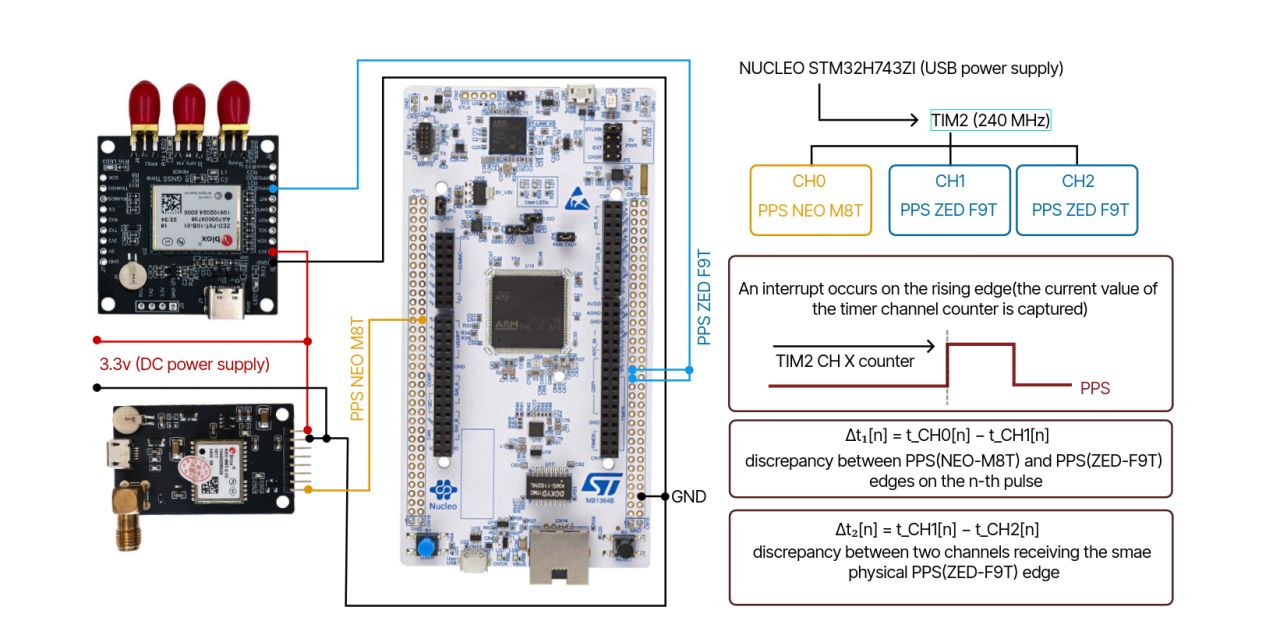
PPS timing system hardware setup

PPS Timing System: From "Why Does This Keep Hanging" to Nanosecond-Level Data

≈ 7.3 ns Receiver-to-receiver jitter (NEO-M8T vs ZED-F9T), with the measurement system noise floor removed in quadrature Overview A follow-up to the VLF recorder work — a parallel project at the Institute characterizing PPS (pulse-per-second) timing accuracy across two GNSS receivers, both running in survey-in mode: a u-blox NEO-M8T and a ZED-F9T. The question was straightforward: How precisely can the PPS outputs of two GNSS receivers be compared, and how much of the measured jitter actually comes from the measurement system itself? ...
August 1, 2026 · Alexander Pryadunets
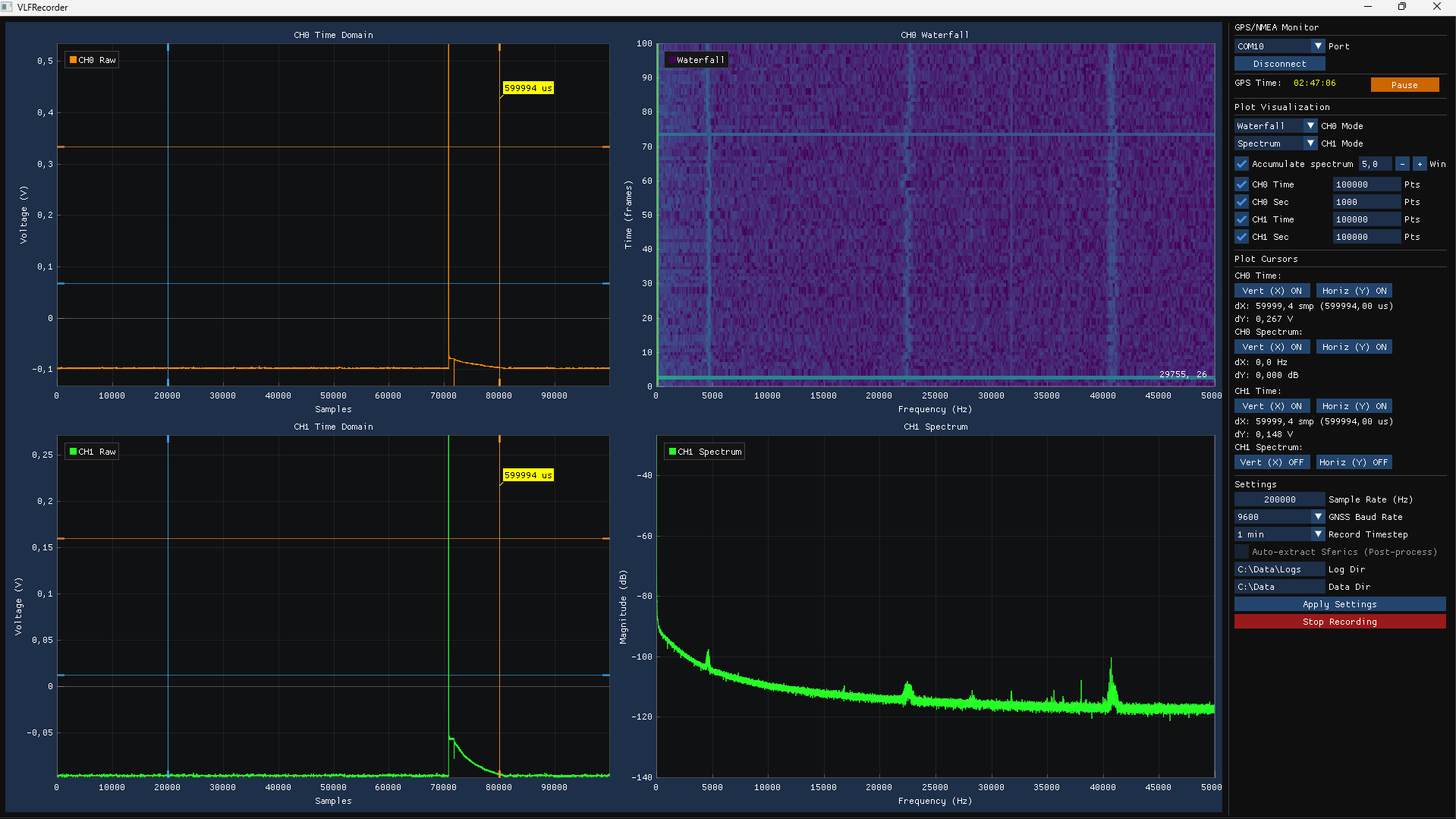
VLFRecorder interface — dual-channel time domain, waterfall, and spectrum view

VLFRecorder: Real-Time Dual-Channel VLF Acquisition Software

2 ch Simultaneous time-domain, spectrum, and waterfall monitoring with GPS-disciplined acquisition and unattended recording Overview VLFRecorder is a Windows desktop application for continuous, unattended acquisition and monitoring of Very Low Frequency signals at lightning detection stations. The application grew from a single-channel proof of concept into a dual-channel real-time acquisition system with: continuous two-channel recording; hardware-disciplined sample timing; GPS/PPS synchronization; real-time time-domain and spectral visualization; scrolling waterfall spectrograms; measurement cursors; GPS-aligned session management; acquisition and connection error logging; automatic post-processing and sferic extraction. The software is used for day-to-day operation of the station’s data acquisition hardware, so the primary design constraint is not simply displaying data quickly. The acquisition pipeline must continue receiving samples while visualization, GPS parsing, file I/O, and analysis are running independently. ...

July 30, 2026 · Alexander Pryadunets